
A Levant.pk Analysis
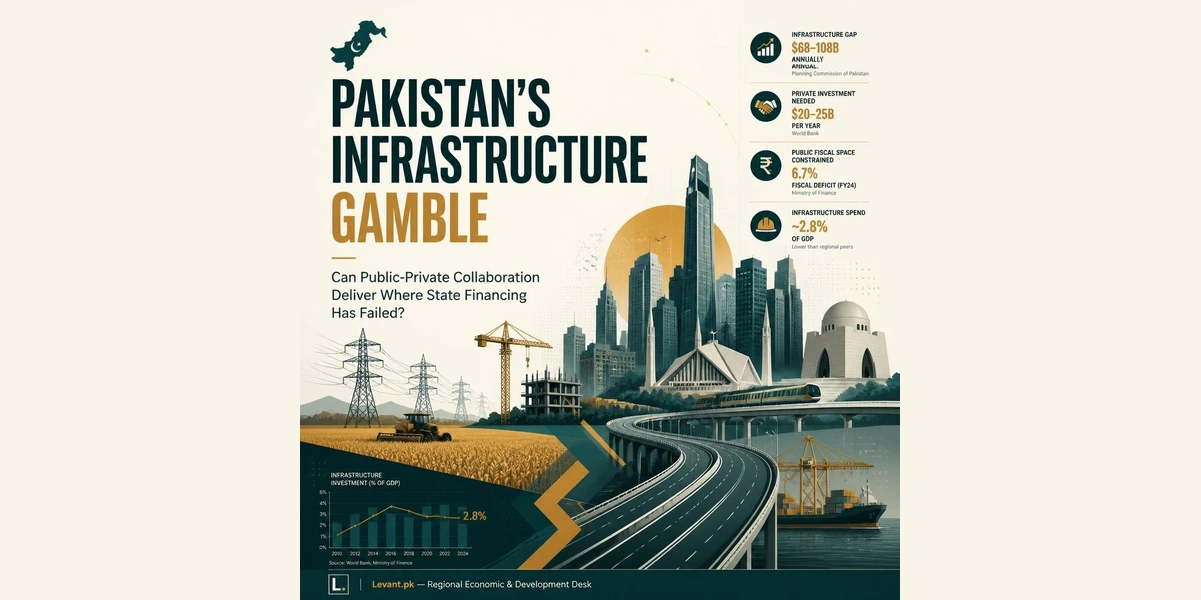
Islamabad’s latest overture to global capital markets landed not in a Karachi boardroom but in London, at the headquarters of the Private Infrastructure Development Group during London Climate Action Week. On paper, it was a routine roundtable — bankers, diplomats, and development financiers trading talking points on mobilizing investment for Pakistan’s sustainable infrastructure and climate transition. In practice, it exposed something more revealing: a country that knows what it needs to build, and how little of it the state can afford to build alone.
The guest list mattered as much as the substance. Chaired jointly by InfraZamin Pakistan’s Maheen Rahman and PIDG chief Philippe Valahu, the session drew Pakistan Banks’ Association chairman Zafar Masud, Bank Alfalah’s Atif Bajwa, British High Commissioner Jane Marriott, and more than thirty representatives from development finance institutions and commercial banks across the UK and Pakistan. Pakistan is no longer simply pitching for concessional aid or bilateral loans; it is courting institutional and blended-capital investors who expect bankable projects and enforceable returns, not goodwill.
The Pipeline Problem
For years, Pakistan’s infrastructure story has been one of ambition outrunning execution — power plants and motorways announced, climate-resilience programs pledged at summits, yet a coherent, investable project pipeline has remained elusive. The roundtable’s chief takeaway was an acknowledgment of exactly this gap: participants called for a multi-stakeholder task force to build a pipeline of investable projects, alongside a coordinated platform linking government, developers, and financiers so project identification doesn’t stall at the feasibility-study stage, as it so often has.
This is not a uniquely Pakistani failing — Gulf and broader Levant markets have wrestled with the same bottleneck shifting from state-led development to blended finance. What distinguishes Pakistan’s case is the scale of the deficit relative to fiscal space. With public debt still above two-thirds of GDP and debt servicing consuming much of federal spending, Islamabad’s balance sheet cannot fund the energy, water, and transport upgrades the economy needs. Private and blended capital is less a preference than the only remaining option.
Two Details Worth Noting
Framing climate-resilient agriculture as a priority investment category — linked to productivity, food security, and economic resilience — represents a departure from the conventional focus on highways and power grids, acknowledging the acute vulnerability of Pakistan’s agricultural workforce to heat extremes and flooding.
Equally familiar was the recurring call for targeted policy support and regulatory incentives to de-risk private capital, alongside a request for better market intelligence to guide financing decisions. Investors are not seeking subsidies; they require regulatory predictability — consistent tariffs, enforceable contracts, and policy continuity across successive governments. This is as much a governance challenge as a financial one, and it remains the area where Pakistan has historically struggled the most.
Reading the Moment
It would be easy to dismiss another roundtable communiqué as diplomatic theatre, with no binding financial commitments attached. But the timing isn’t incidental. It sits alongside a broader push this year: GDP growth hit 3.7 percent in FY2025-26, the fastest in four years though short of target; an expanded CPEC 2.0 agenda for FY2026-27 promises new green-development and digital-infrastructure corridors; and the World Bank has been pressing for a fairer fiscal federalism settlement between Islamabad and the provinces. Together, these point to a state trying, unevenly, to convert fragile stabilization into durable, investable growth — with infrastructure as the connective tissue.
The Verdict, Cautiously Stated
However, such commitments offer no guarantee of delivery. Pakistan has established task forces and investment platforms in the past, many of which quietly dissolved as diplomatic momentum waned. The real test is whether the “coordinated platform” promised in London can generate a pipeline that satisfies the due diligence requirements of Bank Alfalah, PIDG, and the institutional investors in that room — and whether Islamabad can maintain policy incentives long enough for projects to reach financial close. Climate finance pledges are easy to announce but difficult to execute; Pakistan’s recent history is replete with examples of both.
What’s shifted is the framing: Pakistan is positioning itself, at least rhetorically, as a market for private and blended capital rather than a donor-recipient relationship — one where climate-resilient agriculture sits alongside energy and transport as an asset class worth underwriting. Whether that survives contact with Pakistan’s execution record is what every investor in that room, and every reader watching from the region, will be tracking over the next fiscal year.
Levant.pk — Regional Economic & Development Desk